By Vladimir Kovtun
17/10/2025
Preview:
The EU is under significant pressure from Washington to roll back its climate protections. On certain issues, including Corporate Sustainability Due Diligence Directive (CSDDD) requirements, it appears that Commission President Ursula von der Leyen has obliged. Indeed, this may allow for an improvement of transatlantic relations and perhaps increased competitiveness for EU firms. However, even if it is not as flashy as the main news stories of the day, climate change is an imminent, ever-worsening threat for EU citizens. It already is augmenting extreme weather events, killing EU citizens, and fundamentally reshaping member states’ politics for the worse. In the name of ensuring public safety and simply from a cost-benefit perspective, abandoning climate protections would be a mistake for the EU.
Context:
During Commission President von der Leyen’s first term, the EU placed climate change protections at the top of its agenda. At the center of these efforts was the European Green Deal, aiming to transform the EU’s economy so that the union could become carbon neutral by 2050. Under the Green Deal, among other accomplishments, the Union has been able to promote green manufacturing and create a social climate fund, helping vulnerable families receive clean heating. Though there have been some implementation issues, the Initiatives have allowed for significant progress on climate issues, with the EU now being on track to decrease emissions by 55% from 1990 levels by 2030. However, US President Trump believes that these new initiatives and others are unfair towards US exporters and generally sees efforts against climate change as unnecessary. As such, he has emphasized pressuring EU leadership to remove these policies. To the EU’s credit, they so far have not acquiesced on most of their policy, with the key exception of CSDDD.
CSDDD is key to climate regulations because it places a key set of guidelines that European companies must follow when they subcontract production outside of the EU. This includes a requirement that companies ensure their subcontractors respect their workers’ human rights and follow EU environmental standards. Though the US-EU trade agreement addressed workers' rights, climate law was ignored, and the EU’s concession will undermine the enforcement of laws under the European Green Deal. This provides a precedent for further concessions to Washington and other climate skeptic actors, setting the stage for the EU’s climate goals to fall out of reach.
Climate Change today:
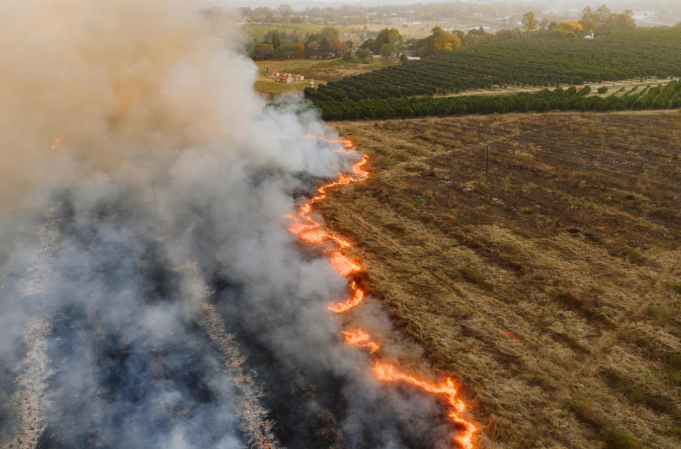
Though obscured by other issues in the public discourse, Europe has faced serious climate-related problems over the past couple of years. In 2025, a record 1 million hectares of the European Union burned as of 28 August of that year. That already made 2025 the worst year for wildfires since 2006, when records began in earnest. ⅔ of these fires occurred in Spain and Portugal, resulting in a serious decrease in air quality for those countries, along with France and the UK. Greece, too, dealt with serious fires, forcing the evacuation of thousands. The current volume of fires has overwhelmed local firefighters, posing an increasing threat to local communities.
Heatwaves also presented a clear and present danger to Europeans throughout 2025. Throughout the summer, life-threatening heatwaves menaced the continent, with temperatures upward of 30 °C being reported as far north as Finland. Even as late as October, areas in Southern France experienced a heatwave exceeding 40 °C. These heatwaves took the lives of 24,400 EU citizens over the course of the year, with studies showing that up to ⅔ of those deaths occurred due to climate change’s effects. Alongside headwaves, Europe has increasingly experienced drought. About ⅕ of the European Union experienced water stress due to drought in 2025. Even in Belgium, trees began to lose their leaves as early as August due to an uncharacteristic lack of rainfall. These droughts are quite consequential, with barges on the Rhine having to sail at half full to account for the river’s lower water levels. With 80% of German waterborne freight going through the Rhine, this threatens the German economy at a time when it is already sputtering.
These problems are already concerning for the European Union, but they are nothing compared to what will happen if climate change is allowed to worsen unabated. According to projections, if global temperatures reach 3°C above pre-industrial averages, the costs of drought alone will increase to 40 billion euros annually from 9 billion today. Even if climate change regulations may have their inevitable costs, the human and economic costs of doing nothing will be far higher.
Climate Change’s negative political effect:
The effects of climate change significantly contributed to the EU’s migration crisis. For example, one of the main factors that caused Syria’s civil war and subsequent mass migration crisis was an unnaturally strong drought from 2006-2010. Desertification displaced large parts of Syria’s farmer and herder communities towards urban areas, worsening socioeconomic conditions. This directly contributed to the sheer magnitude of individuals pushed towards the EU throughout the 2015-2016 migrant crisis. With migration being the main issue drawing the alt-right into the mainstream, it's clear that climate change is perhaps one of the main reasons why they could become so powerful. Seeing how even in Germany migration brought the alt-right from a distant fringe to one of the most powerful political forces in the country, can the EU afford to allow the climate crisis to get worse?
Why deregulation is not the answer:
There are fair arguments against the EU’s climate direction. Given that the EU has the most stringent climate standards among the world’s major economies, it has inherently put itself at a competitive disadvantage. It can be argued that policies like low-emissions zones can harm those unable to buy modern cars, and that phasing out non-renewable industries like coal will threaten the livelihoods of low-skilled workers. Farmers also have valid concerns that cheaper imports will affect their livelihoods. Issues like these should be the impetus for reforms to climate policy, but not a reason to abandon them altogether. Though regulations may harm certain businesses, the policy unpredictability that would emerge from a Washington-inspired reversal would be worse. Economic uncertainty has shown itself to delay investments, cause a rise in borrowing costs, and discourage spending. For these reasons, large European companies have come to support strong sustainability rules.
Improving Relations with Washington?:
There is also the issue of whether acquiescing to Washington’s demands will actually improve the transatlantic relationship. The key problem at hand is that President Trump sees European leadership as a political opponent. He has identified himself with the cause of the European far right, with his administration endorsing the campaigns of the Romanian and Polish alt-right right respectively, in their national elections. At his Munich speech, President Trump’s Vice President JD Vance outlined a clear US opposition to European democratic practices. He even insinuated that European actions against the far right undermined the point of NATO. Although he framed his words in an attempt to improve democracy, there was a clear sense that he viewed the EU as a political opponent with parallels to the Soviet bloc. This ideological difference is not going to disappear with a few climate concessions. As such, even if removing climate protections may improve relations with Washington in the short term, in the mid-term future, it will only weaken the EU’s hand in its inevitable next disagreement with US leadership.
Continuing success:
The EU may have developed a successful climate policy, which should not be gutted, but there is always room for improvement. One of the biggest problems EU climate policy has faced is that it seems inaccessible to the public. Problems such as increased costs for disadvantaged communities, or even for farmers, are fair concerns. They only get taken out of proportion by those like the European far right or President Trump because those are the loudest voices speaking to ordinary people. These problems could easily be solved through greater public engagement in policymaking, perhaps even with a People’s Assembly working alongside EU institutions. The average person may not be fully educated in these topics, but they can cover policymakers’ blind spots with their own experiences. Far from being uninformed, research shows the public is ahead of the politicians on the need for action to combat climate change. And most of all, it would allow for much-needed publicity of the EU’s point of view. Democracy is built on listening to the voices of the public - including dissenting voices. But the dissenting voices the EU should base its work on should be those from within, and not an ocean away. Only then will the EU have the full standing to challenge the US’s attempted coercion of its climate policy.
Sources:
https://commission.europa.eu/strategy-and-policy/priorities-2019-2024/european-green-deal_en
https://www.politico.eu/article/eu-emissions-goal-2030-climate-energy-goals/
https://www.bbc.com/news/articles/cd6n8qqlj8go
https://www.euronews.com/2025/08/10/new-heatwave-continues-unabated-in-southern-europe
https://www.brusselstimes.com/1708898/trees-are-losing-their-leaves-early-due-to-drought-stress
https://climate.ec.europa.eu/climate-change/consequences-climate-change_en
https://shs.hal.science/halshs-04982036v1/document
https://europeandemocracyhub.epd.eu/how-a-new-global-citizens-assembly-can-revive-climate-action/
Do you like this page?