By Vladimir Kovtun
24/10/2025
Preview:
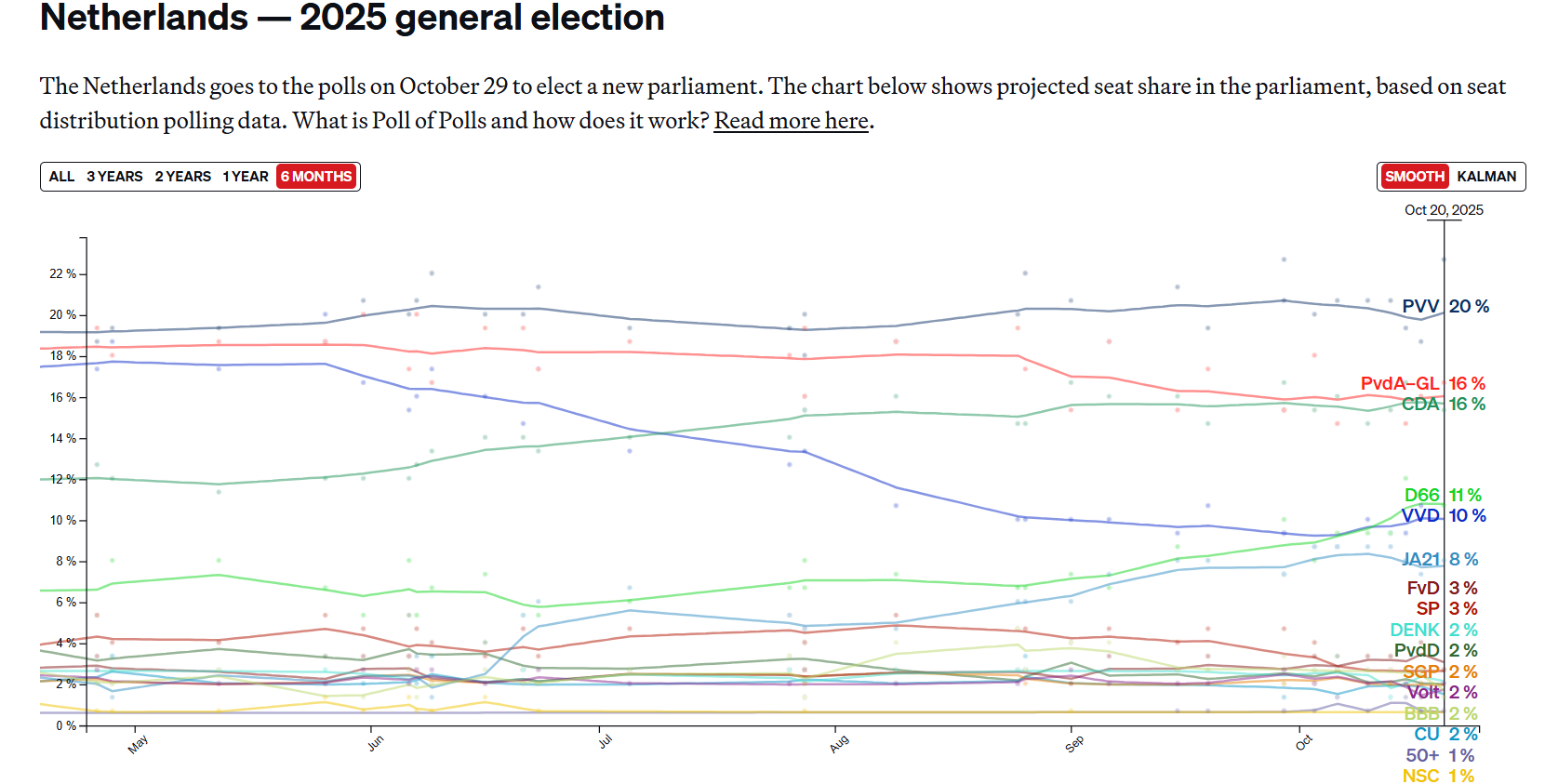
The Netherlands will experience a new election on 29th October. After a tumultuous year of right-wing governance under the Dick Schoof cabinet, it seems as if the Dutch public is quite divided. The far-right Dutch Freedom Party (PVV) still leads in the polls at 20%. However, their lead has notably shrunk since the 2023 election, when they won 24% of the vote. Meanwhile, they are challenged by the centre-right Christian Democratic Appeal (CDA) and left-wing Labor&Green (PDVA-Groen Links) party, which have both reached 16% support, along with other moderate parties. It seems as if no party will win more than 20% of the vote, or will even come close to a strong plurality. Can a centrist government be made? Or will the right still hold onto power? If there’s only one given, the Netherlands' political troubles are far from over.
(Politico, 2025)
Context:
After dominating Dutch politics from 2010 to 2023, former PM Mark Rutte and his center-right VVD party saw their government fall due to a disagreement over migration policy. The issue of immigration provided fuel to the radical right PVV, which surged ahead to be the largest party in Dutch politics on a wave of nativist sentiment. The resulting election in 2023 saw the creation of a 4-party coalition consisting of the PVV, VVD, New Social Contract (NSC), and Farmers’ Party (BBB) after lengthy coalition talks. It was the most right-wing coalition in recent Dutch history, with open discussions of ideas like remigration and omvolking (Dutch version of the Great Replacement Theory) normally taboo in political discourse. However, they failed to pass many notable policies during their time in office. As such, eventually the PVV left the coalition due to the perceived slow implementation of stricter immigration policy, collapsing the government.
Alongside the debates on migration, a worsening housing crisis has emerged as one of the most contentious topics raised during the Dutch elections. Housing has become increasingly unavailable and unaffordable in the Netherlands, with the country experiencing a shortage of 400,000 homes. As center-left Democrats' 66 leader Rob Jetten put it, “All pigs in this country have a roof above their head — but a student or first-time buyer cannot even find an affordable broom cupboard”. Most parties agree that the Netherlands needs to build more houses, with the PVV claiming that they would do so by converting the Netherlands’s public media headquarters into a residential complex, and PvdA claiming they would convert two airports into housing. More controversially, there has been a debate around removing the Netherlands’ generous mortgage tax relief. This policy was initially adopted to encourage homeownership. However, with the country’s low homeownership rates by EU standards and the upward pressure this policy has placed on mortgage prices, the policy has worked to worsen housing inequality. Most parties in the center and left of Dutch politics support phasing out the tax break, most crucially including the CDA and PvdA. However, the VVD and far-right parties have taken a staunch stance in favor of the policy, claiming its abolition would harm homeowners. The VVD has even announced that it will not join a coalition with a party that supports phasing out mortgage tax relief. This is despite the fact that, according to research by ABN Amro, most homeowners don’t need help to finance their bills.
The Left’s prospects of building a coalition:
The Dutch left has consolidated, but they do not seem to have the support to create a coalition alone. In June, the Green and Labor/PvdA parties came together to create the “Groen-Links PvdA”. They together poll at 16%, making them the second-highest polling list in the Netherlands. The main issues their platform focuses on are increasing the housing supply, ending fossil fuel subsidies, and deploying a 25% Future Fund to promote green development. Despite this, even alongside smaller left-wing parties like the Socialist Party (SP), their support base sits at 20%.
The Center’s prospects of building a coalition:
On the surface, it seems as if the combined center and left are in a favorable position to create a coalition excluding the far right. The two parties that have gained the most in the polls are Democrats 66 and the CDA, polling at 11% and 16% respectively, as compared to their 6% and 3% results in 2023. D66 is a social-liberal party that holds mainly center-left positions. Their main policy goals are to lower the voting age to 16, build 10 new cities' worth of housing supply, and encourage sustainable entrepreneurship. This platform would provide a good bridge between the CDA and the PdvA. If these parties were to work with the PvdA and smaller left-wing parties like SP or Party for the Animals, there is a plausible route to a majority coalition. Yet notable barriers remain that may prevent a left-center coalition. The CDA has its own tensions with the left, especially with PvdA’s criticism of CDA leader Bontenbal’s position that he would not interfere with Reformist schools that teach that homosexual relationships are wrong. Additionally, according to a September internal poll, only 52% of CDA voters would find a coalition with PvdA to be acceptable. As such, unless circumstances seriously change, the CDA may be reluctant to be a part of a coalition between the left and center.
The Right's prospects of building a coalition:
The right could very well create a coalition, but it would require serious pragmatism, and yet the inclusion of the far right. With only 20% support, the PVV will have to concede to the center to create a new government, something which may be difficult to accomplish given the circumstances behind the previous cabinet’s dissolution. And yet, without the PVV, a more center-right coalition including VVD, BBB, JA 21, and CDA could only reach 38% support according to the most recent polls.
The key player needed for a right-wing coalition to form will be the wild card that is the modern VVD. The party has changed a lot from being the center-right party of PM Mark Rutte. Since the appointment of its leader, Dylan Yesilgöz, the party has been quite erratic, being wracked by controversy for moving to the right on migration, ever-changing support for the PVV, and the perplexing handling of the Douwe Bob controversy. With the current direction of the VVD, its moves during any coalition-building process are hard to predict. Yesilgöz claims that the party will not enter another coalition with the PVV. Yet, they also claim they will not work with PvdA or D66 due to their left-wing stances. It is hard to predict which one of these promises will be abandoned in the coalition-building process, but given that doing both would lock VVD out of any potential coalition, it is unlikely that they will be kept. It also has to be noted that recent events have seen the erosion of the party’s base, falling from 22% to 15% between the 2021 and 2023 elections, and then falling further to just 10% according to current polls. As such, the only thing that can be ensured in the party’s attempts to regain relevance will be the unexpected.
Continued effects of the current government:
The rise of the alt-right has created one lasting impact - a shift of Amsterdam’s overton window to the right on migration-related topics. According to the Dutch Bar association, ¾ of the parties on the ballot for the upcoming elections have at least one proposal that violates the rule of law. The PVV unsurprisingly has 30 violations in and of themselves, but even more socially liberal parties like D66 had similar violations. The main reason for this has been that since the last elections, party leaders across the political spectrum have taken away a lesson that voters want stricter migration laws. As such, in any case, stricter migration laws will remain part of the status quo for the Netherlands, even if studies show that these moves do not have a tendency to strengthen centrist parties.
Takeaways:
In the aftermath of this election, there will likely have to be a lengthy coalition-building process, creating a broad coalition government. By no means will this election provide a real victory for any of the parties involved. It also seems as if the next Dutch government will be quite politically fragmented. Especially if it contains the PVV, such a government could easily collapse in the near-term future due to yet another disagreement on migration policy. The Right may be slightly favored over the center in forming a government, but their infighting might still preclude any political successes. Though the Netherlands does not face the same economic or social challenges seen in France, this electoral gridlock threatens to create a similar unending political crisis and the implications that would entail.
Sources:
https://www.politico.eu/europe-poll-of-polls/netherlands/
https://www.bbc.com/news/world-europe-67504272
https://edition.cnn.com/2025/06/03/europe/netherlands-government-collapse-geert-wilders-intl
https://nos.nl/collectie/14002/artikel/2586706-partijen-eens-over-woningnood-verdeeld-over-de-aanpak
https://apnews.com/article/netherlands-election-timmermans-wilders-f9daa81b2c5f22ea73b2c379f729e9b6
https://d66.nl/wp-content/uploads/2025/09/Election_program_2025-2030.pdf
https://www.dutchnews.nl/2025/08/support-for-the-vvd-plunges-again-cda-firmly-in-third-place/
https://nltimes.nl/2025/06/09/vvd-leader-says-party-will-longer-form-coalition-pvvs-geert-wilders
https://nltimes.nl/2025/06/09/vvd-leader-says-party-will-longer-form-coalition-pvvs-geert-wilders
https://nltimes.nl/2025/10/18/vvd-rules-joining-left-leaning-cabinet-groenlinks-pvda-cda-d66
https://www.dutchnews.nl/2025/10/far-right-leads-the-pack-with-election-plans-that-break-the-law/
https://edition.cnn.com/2025/06/03/europe/netherlands-government-collapse-geert-wilders-intl
Do you like this page?