
By Jeremy Schaefer
25/04/2025
Moldova will hold its parliamentary elections on September 28th.
Parliamentarians in Chișinău voted last Thursday to hold elections then, a decision that could reshape the entire political landscape and future of the country. Sandwiched between EU-member Romania and fellow EU-candidate Ukraine, Moldova is, of course, a small landlocked country that relies heavily on its agricultural production and Foreign Direct Investment. (It is also known for its wine, which I certainly recommend giving a try.)
After Russia invaded Ukraine in February of 2022, Moldova welcomed and hosted a large number of Ukrainian refugees within its borders. It still does. And one month later, in March of 2022, the Republic of Moldova officially applied for EU membership under the leadership of President Maia Sandu. In June of the same year, the European Union granted Moldova candidate status and negotiations officially opened in July of 2024. Ms. Sandu, who recently won reelection back in October, and her fellow Party of Action and Solidarity (PAS) members currently hold ⅔ of all seats in the federal parliament.
This may very well not be the case come the end of September. In the same election from October that sent Ms. Sandu back to the presidency, Moldovans also voted in a referendum to decide whether the country should continue pursuing EU membership. It passed, but by the slightest of margins: 50.4% voted in favor of EU accession while 49.6% opposed the motion. If this fall’s election is as close as last October’s was, the PAS will likely not hold its majority and will be forced to form a new coalition government. Current polls from Moldova support this; they are showing that no party is expected to win enough seats to maintain an absolute majority and that the PAS will perform worse than it did last year and in 2021’s parliamentary elections.
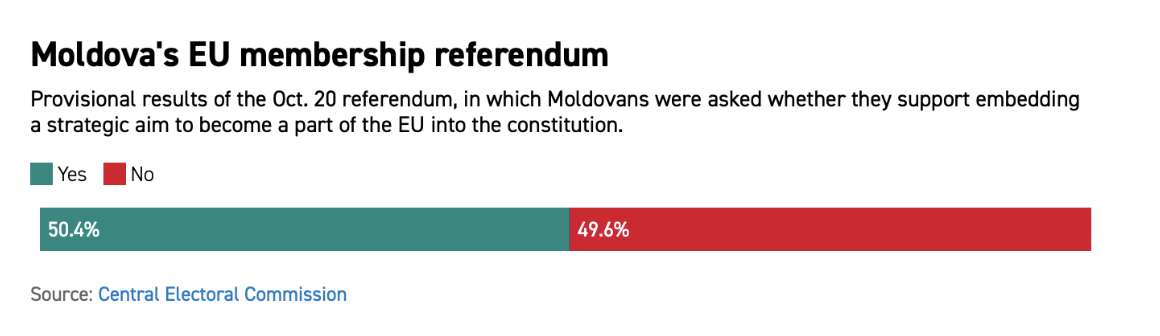
Image Source: Politico’s Gabriel Gavin
A former member of the Soviet Union, Moldova has long struggled to release itself from Moscow’s firm grip on the country’s political, cultural, and linguistic makeup. Russia is also accused of interfering with the October election by “funneling cash through its proxies into the accounts of ordinary voters, as well as using social media to sow fears about the prospect of EU membership leading to a direct conflict with Russia.” This omnipresent influence from the Kremlin remains a major problem that has, and certainly will continue to, slow Moldova’s accession negotiations.
Nonetheless, the EU-accession referendum passed and Moldovan parliamentarians can now begin amending the country’s constitution to be more-aligned with the European Union’s acquis communautaire. Though this process has begun and Ms. Sandu is firmly set on having her country join the EU by 2030, progress could be halted once Moldovans head to the polls again this autumn. Moldova’s President of Parliament, Mr. Igor Grosu, noted that this September’s election will be “crucial” and that the country will either “throw away everything we’ve achieved on our path to modernization and EU integration, or [will] move forward toward peace and development.” The governing PAS party hopes to see a large turnout in favor of the EU, especially from Moldovans living abroad. In doing so, Moldova just may preserve its sovereignty, its freedoms, and secure itself more assistance from Brussels.
Also in October of last year, the Council approved the Moldova Growth Plan, a new pathway to support EU-related reforms and economic growth in the country. Perhaps the most substantial piece of the legislation is the Reform and Growth Facility, a €1.9 billion assistance package that will stimulate the Moldovan economy between 2025 and 2027. Of this, “€385 million [is expected to be] in grants and €1.5 billion in loans. These loans will be highly concessional, with long repayment time and advantageous interest rates.” Furthermore, since the war in Ukraine broke out, the EU has allocated more than €84 million in humanitarian assistance for Moldova.
As of now, Brussels, Chișinău, and Moldovan citizens all appear set on EU membership for the country; however, the upcoming parliamentary elections in September will provide a better indication of the latter’s current attitude.
Much is left to be decided before Moldova can officially join the world’s most exclusive international club. The frozen conflict in Transnistria, for example, certainly remains at the forefront of minds in both Brussels and Chișinău. Though it’s impossible to know exactly how Moldovans will vote in September, or if the country will meet its aspiration of EU membership by 2030, it is clear that Moldova’s future is at a crossroads. So long as the war in Ukraine persists, Moldovan sovereignty too hangs by a thread. So, this fall, Moldovans must decide for themselves, as they did back in October of 2024, which side they would like to more-closely be entangled with: the West with the EU or the East with Russia.
References:
Bodnar, Oxana. Hotnews, 16 April 2025. https://hotnews.ro/alegerile-parlamentare-in-republica-moldova-urmeaza-sa-aiba-loc-pe-28-septembrie-ce-arata-acum-sondajele-1949685
Gavin, Gabriel. “Moldova votes yes to joining EU by tiny margin.” Politico, 21 October 2024. https://www.politico.eu/article/moldova-votes-yes-join-european-union/
Giordano, Elena. “Moldova to hold ‘crucial’ elections on Sept. 28.” Politico, 17 April 2025. https://www.politico.eu/article/moldova-to-hold-crucial-elections-on-sept-28/
“Moldova.” The Council of the European Union. https://www.consilium.europa.eu/en/policies/moldova/
“Moldova: Council gives final green light to support reforms and economic growth with €1.9 billion.” The Council of the European Union, 18 March 2025. https://www.consilium.europa.eu/en/press/press-releases/2025/03/18/moldova-council-gives-final-green-light-to-support-reforms-and-economic-growth-with-almost-2-billion/
Do you like this page?