
By Morgann Darche
10/04/2026
How can elections in a small country in Europe mark a turning point for the future of the continent?
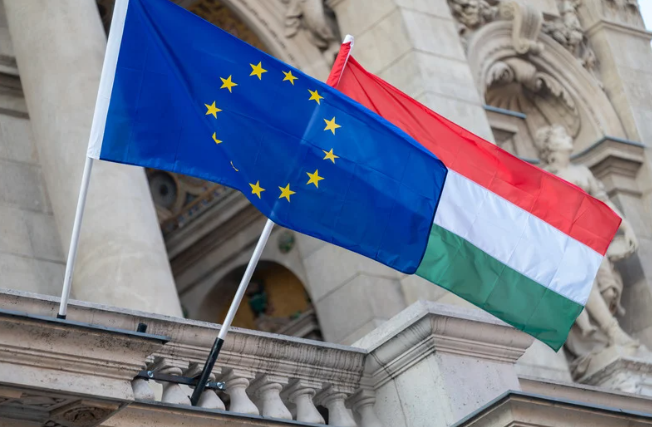
On 12 April, Hungary will hold its most consequential parliamentary elections in years. Recent polls put opposition leader Péter Magyar's Tisza party at 58% - far ahead of Viktor Orbán's Fidesz at 35%. After sixteen years in power, the man who turned Hungary into Europe's blueprint for illiberal democracy is facing his most serious threat. With a system built on media control, judicial capture and rural patronage now seemingly turning against him, and with Magyar's rise from Fidesz insider to opposition leader, the question is no longer just who will govern Hungary - but what the answer will mean for the future of democracy across Europe.
Sixteen years in power: Orbán's legacy
To understand what is at stake, one must first understand what were the ‘
“achievements” of Orbán’s mandate. Mostly, over four successive governments, he has turned Hungary into what he calls an “illiberal democracy”, positioning himself as Europe’s defender of traditional Christian family values against western liberalism and multiculturalism. His four successive governments have progressively eroded the rule of law in Hungary and his party’s supermajority has enabled him to rewrite Hungary’s constitution and pass laws consolidating executive power, making hundreds of changes to electoral rules, severely weakening judicial independence and curbing NGOs and media freedoms. Today, up to 80% of the country's media functions as a propaganda machine for Orbán and his far-right Fidesz party.
Regarding his position towards international issues, he is now seen as the EU’s disruptor-in-chief - especially regarding the topics of justice, migration, LGBTQI+ rights and aid for Ukraine, which along with sanctions against Russia he has consistently blocked (notably the latest 90bn loan). Indeed, Orbán is the EU’s most Moscow-friendly leader, continuing to buy Russian oil and gas and to meet Putin despite the ongoing war in Ukraine. He has especially made hostility to Ukraine and its president a cornerstone of his election campaign.
Far from isolating him, these positions have made him a model for Europe's growing band of nationalist parties - endorsed by Meloni and Weidel but also by the current Trump Administration with Vice President JD Vance visiting Orbán in Budapest just days before the election.
Yet this system, built over sixteen years, now appears to be turning against its architect. The same voter anger against "corrupt ruling elites" that Orbán once channelled, is now directed at him. His government has been repeatedly accused of draining state coffers and awarding public tenders to companies owned by close associates - bridges, football stadiums, motorways. Notably, his son-in-law owns a string of prominent hotels; his childhood friend, a former gas fitter, has become the wealthiest man in the country. Yet, Orbán refuses to answer questions about any of it.
Magyar: the opposition from within
These domestic and international political positions have led to popular unrest and to the formation of a strong opposition that was able to take form during the campaign for the elections of this. The opposition is personified by Péter Magyar, 45 years old, formerly a Fidesz disciple and formerly working as a Hungarian diplomat in Brussels. In February, 2024 he abruptly quit the party and gave an interview which garnered two million views within days, accusing the government of cowardice and corruption. He then founded the Tisza party which won 30% of the vote in the June 2024 European elections in Hungary, finishing second to Fidesz.
Even though the two men originally were in the same party, the contrast between them is striking. Orbán, 62 years old, comes from a rural background, Magyar is a Budapest lawyer by training - slick and urbane, as his critics say, seemingly ill-suited to reach the rural electorate that forms Fidesz's heartland. Aware of how this part of the population perceives him, Magyar has toured the countryside for the past two years. And unlike Orbán, he focuses on domestic issues such as healthcare, education, transport and rural depopulation, therefore responding more to the people's concerns. He has also relied heavily on broadcasting his rallies live on Facebook, drawing hundreds in villages and tens of thousands in provincial Fidesz strongholds, which has allowed him to bridge the media gap between himself and Orbán, who has a significant portion of the country's media at his disposal.
Regarding his position towards international issues, contrary to Orbán, Magyar has pledged to return Hungary to pro-EU orientation, end its dependence on Russian energy, restore an independent public media and judiciary, boost the economy, halt huge Orbán-era corruption, sanitize public procurement and unlock frozen EU funds.
However, Magyar is no stranger to controversy himself. His ex-wife - the former Justice Minister under Orbán - depicted him as an unstable figure, prone to bursts of anger and domestic violence. More recently, Fidesz allegedly convinced a former girlfriend to take him to a party where cocaine was being used. But these scandals do not seem to be enough to tarnish his image or significantly affect the poll numbers.
A campaign under pressure
Indeed, Magyar represents a real threat for Orbán and the latter acts accordingly. Well aware of Magyar’s popularity, Orbán has sought to frame Sunday’s vote as a choice between war or peace, telling voters they can preserve Hungary by electing him, or plunge it into chaos and war by choosing Magyar, whom he paints as an agent of Brussels and Kyiv. Analysts even argue that Russia appears to be actively supporting this narrative, helping shift the conversation away from the bread-and-butter issues that have propelled opposition leader Magyar’s party to the top of the polls.
Another strategy Orbán employs relies on his strongholds in rural areas. In the countryside, Fidesz has built a strong system of local patronage in villages since 2002. As a result of this system, mayors decide who receives work, and who gets firewood in winter. And this way of functioning could have a decisive impact on the result of the elections. In fact, a documentary revealed that there were incentives for voting in these villages, including cash payments of €120 per vote, food coupons, prescription medicines and even illegal drugs in exchange for voting for Fidesz. Those who refuse say they are denied the chance to participate in public work schemes, often the only local employment available. Thus, the local patronage plays a major role in the number of votes Orbán received.
However, despite these strategies, until now, most opinion polls put the opposition Tisza party and its leader Péter Magyar far ahead of Orbán’s Fidesz - the latest by 58% to Orbán’s 35%.
Three scenarios and their consequences
So what is to expect for these elections? Would Orbán or Magyar win? And what would be the consequences for each of these outcomes?
If Orbán wins, he would almost certainly double down: conflict with the EU would intensify and domestic authoritarianism would increase. And a victory for Fidesz in this election would add momentum to the chances of far-right parties in France, Germany, Poland, Spain and Portugal.
If Orbán loses but contests the result - particularly if the margin is narrow - the EU would face an entirely unprecedented situation, potentially leading to the suspension of Budapest's voting rights.
A Magyar victory acknowledged by Orbán would certainly ease EU-Hungary relationships, although the opposition leader is hardly a progressive, and Hungarian policy on issues such as immigration is unlikely to change much. Domestically, moreover, unless Tisza wins a supermajority of 133 seats, its room for manoeuvre will be limited: Orbán has ensured many laws need a supermajority to be changed and has stuffed all major state institutions with loyalists. Restoring the independence of the courts, the state prosecution service, the public media and the intelligence services would top the agenda - but how quickly a Tisza government could deliver would depend entirely on the margin of victory.
Conclusion
Thus, this election will have a lot of consequences that could go far beyond Hungary, playing a role on the international stage out of all proportion to its size. Domestically, it represents the prospect of freeing Hungarian citizens from what has become a near-autocratic regime. Internationally, a Magyar victory would send a powerful signal - to the EU, and to the United States - that Europe is not willing to abandon its democratic values, and remains committed to a fair resolution of the war in Ukraine. If that signal does not come, the EU will face an even harder fight for what it stands for.
Sources
https://www.theguardian.com/world/2026/apr/03/hungary-elections-viktor-orban-who-will-win
https://www.bbc.com/news/articles/czd7y1n3jyjo
https://www.bbc.com/news/articles/cyv16lq2rp1o
https://www.euractiv.com/news/orban-fuels-anti-ukraine-mood-ahead-of-hungarian-vote/
Do you like this page?