
By Vladimir Kovtun
15/09/2025
Preview:
On September 8th, France experienced the fall of the government of Prime Minister Bayrou, its second Prime Minister to fall in a year. The crisis threatens to exacerbate the country’s political polarization and paralysis, further eroding President Macron’s credibility in governing the country. It is already bolstering France’s rising far-right fringe, posing a major challenge to the country’s commitment to European integration and values. Given France’s crucial role within the EU, this crisis of confidence should serve as a clear indicator of the need for European moderates to reconnect with average voters and reclaim the popular narrative from the alt-right.
Context:
The origins of this political crisis lie in France’s worsening debt crisis. As of 2024, France’s national debt has reached 3.345 trillion euros, 113.9% of the country’s GDP. Worryingly, its national deficit was as high as 5.8% in 2024, almost double the EU target of 3%. This is combined with a significant drop in GDP growth, with France’s 2025 growth projected to fall to 0.6% from an already underwhelming 1.2% in 2024. According to Carrefour’s Chief Executive Alexandre Bompard, “Only consumption is driving French growth right now”. As a result of these developments, investors have begun losing confidence in the French economy, with borrowing costs reaching as high as 3.53%. If the status quo continues, servicing the debt will become the largest single item in the French national budget by 2029. To combat this crisis, Prime Minister Bayrou proposed a plan including 44 billion euros of budget cuts, aiming to reduce the country’s deficit to 4.6% by 2026. These cuts were widely unpopular due to their impact on France’s social safety net; as such, the big-tent coalition leading France, ranging from the left-wing Nouveau Front Populaire (NFP) to the center-right Les Républicains, was never likely to agree to them. Since the budget vote acted as a vote of no confidence when it was held, Prime Minister Bayrou’s government fell, with only 194 out of 573 MPs voting in favor of his government. This crisis highlights a continued trend of debt crisis-caused political instability, seeing that France’s previous prime minister, Prime Minister Barnier, saw his government fall due to a similar budget plan in November 2024. As it seems, France has found itself in a crisis that its leaders have little political ability to solve.
Why does this crisis matter?
(Politico, 2025)
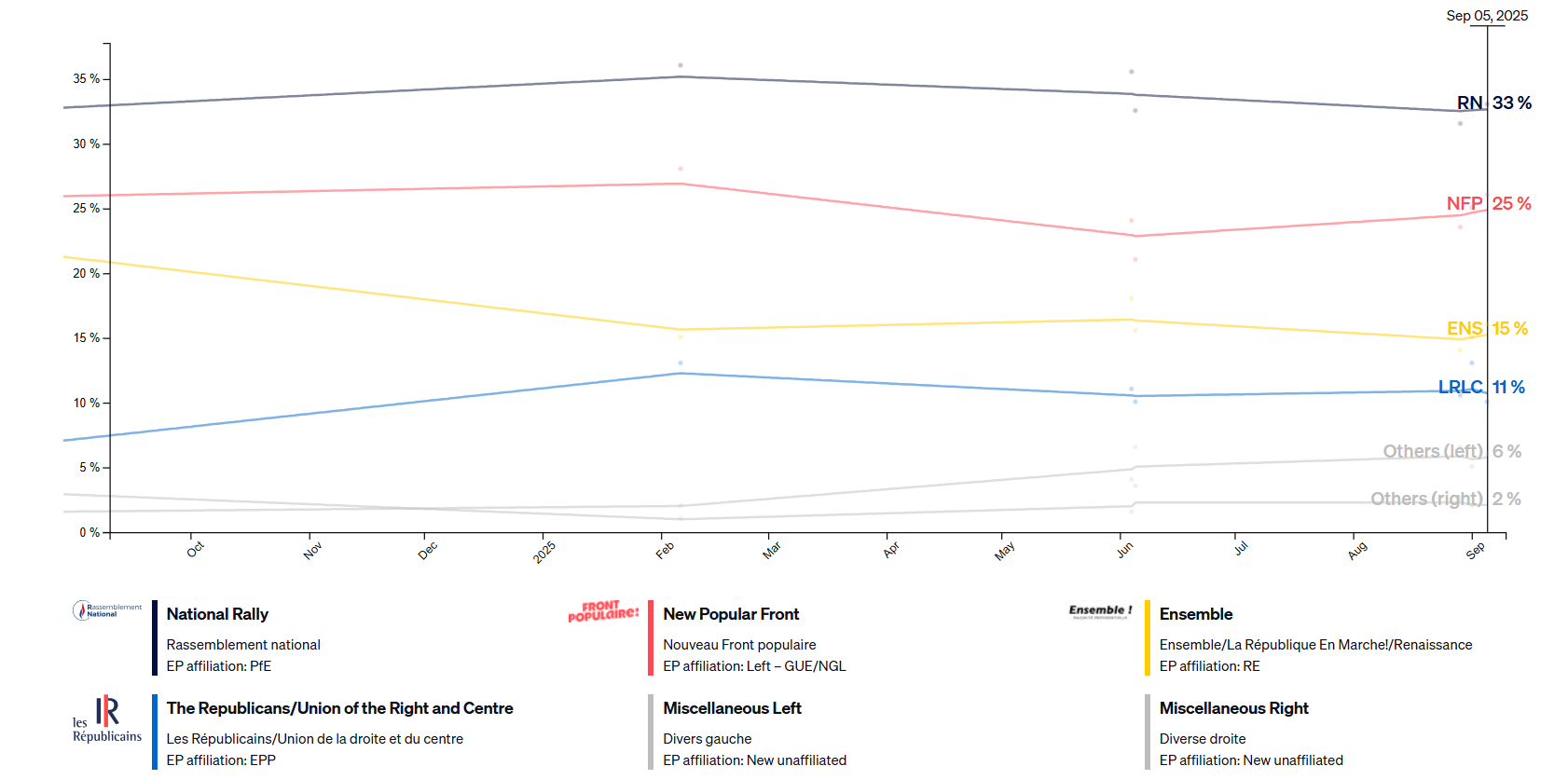
With France’s current political environment, the results of a new election could be disastrous. The far-right National Rally (RN) is the highest polling party in France, at 32% - 3 points higher than their 2024 election results. They are fundamentally opposed to the ideals of the European project, with their opposition to the principle of Schengen and the corruption conviction of their leader, Marine Le Pen. They are followed by the blanket left-wing coalition New Popular Front (NFP) at 23%. The NFP consists of a diverse range of parties from the centre-left Socialist Party to the populist La France Insoumise. None of them support the budget plan, even the Socialist party quickly confirmed that they would oust Prime Minister Bayrou when he presented his budget proposal. On the other hand, President Macron’s Ensemble’s support has fallen significantly over the past year, from 21% at the time of the last election to just 15% as of recent polls. It can also be said that the last election in 2024 arguably helped create the current gridlocked situation, given that it granted Ensemble and their allies an even smaller minority government when they could scarcely afford it.
Despite all of this, a new election seems to be the only way for France to create a more functional government in the mid-term future. Replacing the Prime Minister will not change the fact that Ensemble maintains a minority government in the French parliament, reliant on the implicit consent of the NFP and RN to remain in power. Though creating a new government through negotiation does not risk a disastrous RN electoral victory, it will result in yet another broad coalition in power, unable to agree on solutions to this debt crisis. Such a situation ensures that France’s next government will fall under the same circumstances as Prime Minister Bayrou’s government, deepening a continuous political crisis that will benefit the far right in France’s 2027 presidential race. With the RN’s deeply anti-European agenda, allowing the current situation to continue is highly dangerous to the European Union at a time when it already faces threats on all sides. There is a clear need for moderate parties to regain the trust of the French people by showing they are capable of implementing common-sense solutions to this crisis.
Solutions
At this point, though elections are not likely in the short term, a lack of preparation for them now will only increase the far-right’s advantage whenever they eventually happen. The RN is well aware of this situation, with Jordan Bardella, leader of the RN, being quoted as saying, “There is one way out of this political deadlock: returning to the ballot box”. French moderates need to campaign as if the elections will be held soon and challenge the populist stranglehold on popular opinion. Any such effort would have to include a vast social media initiative to overcome the notable advantage that the far right has built within social media platforms. They have seemingly mastered the algorithms to push young people towards radicalization, showing the need for moderates to focus on modernizing their strategy. The poll numbers speak for themselves: President Macron’s current political strategy is plainly not working, and moderate politicians are in desperate need of greater public outreach to gain a broader base of support.
It is undeniable that any cuts to French government spending will be painful on some level. However, given the need to reduce France’s deficit, cuts are unavoidable. The best option will be to create a plan for budget cuts that minimizes pain for the French public and grants French moderate parties as good a position as possible in the next elections. To do this, France could incorporate further tax increases on the wealthy while eliminating certain cuts to social programs in future budget plans. These tax increases would be based on the Zucman tax already proposed by the Socialist party, which proposed to levy a minimum 2% tax on individuals with assets exceeding 100 million euros. The Zucman tax in and of itself was projected to create 20 billion euros in savings a year, roughly half of what Prime Minister Bayrou tried to accomplish. However, given the plan's opposition in the French Senate, it would need to be rebalanced with elements like additional tax incentives for particularly new or innovative businesses. The combination of a Zucman-adjacent tax with targeted budget cuts would create similar savings as Prime Minister Bayrou’s budget would have achieved, while hopefully increasing the chances of gaining crucial NFR support for a new French budget. France may already have high tax rates, but given France’s minority government, concessions will need to be given to the left to make any proposal politically feasible.
France’s political and economic woes are a clear signal that even in a country as central to the EU as France can face severe crises that empower eurosceptic voices. Ultimately, a democratic society is controlled by its people, and pro-European leaders need to keep their people aligned with their narrative in order to ensure the future of the European project. To this effect, European leaders need to be proactive in solving economic crises as they emerge, innovative in adapting to new tools like social media for political outreach, and open to adapting popular ideas from the left or right, even if they do not directly align with their political beliefs. Hopefully, France’s new Prime Minister, Sebastien Lecornu, will demonstrate an ability to adapt his solutions to this crisis in a way that addresses public concerns; European unity relies on it.
Sources
https://www.ifop.com/wp-content/uploads/2025/09/121832-Resultats-Le-Figaro.pdf
https://www.politico.eu/article/france-far-right-call-new-election/
https://www.ft.com/content/cb72fdc3-5f0c-46ae-87dc-9f7d8a4e0cdf
https://www.aljazeera.com/economy/2025/9/2/why-is-frances-government-on-the-brink-of-collapse-again
https://www.bbc.com/news/articles/cdxz934p56qo
Do you like this page?