
By Morgann Darche
08/05/2026
How can citizens' assemblies help reverse the tide of democratic erosion in Europe - and what does it take to make them work?
With concrete recommendations on the table and cautionary tales from France and Brussels, the question is no longer whether citizens' assemblies are useful - but how to ensure they are actually taken seriously.
Why Bologna? Why Now?
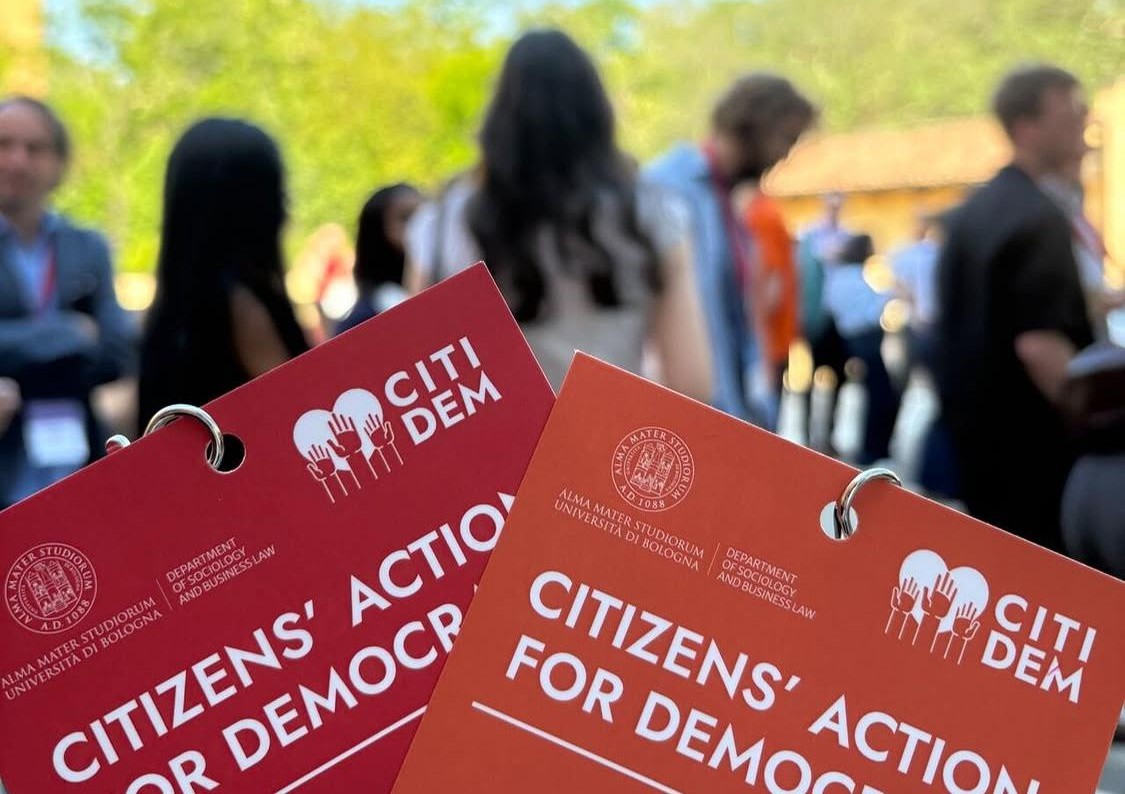
Last week, the Stand Up For Europe team traveled to Bologna as partner in the CITIDEM project, an initiative designed to strengthen democratic participation across Europe to discuss how citizens’ assemblies operate and how we can make them even more effective. This tool is becoming increasingly important in light of the growing discontent of citizens towards their elected representatives and the perceived democratic, challenges opening the door to populist and undemocratic actors across Europe. As part of the CITIDEM consortium and the Citizens Take Over Europe (CTOE) Coalition, our role at Stand Up For Europe is to promote the use and formal integration of these tools for democratic participation into the decision-making process both at local and EU level, and we are constantly striving to improve their impact and effectiveness.
The CITIDEM Project: Building the Foundations for Democratic Participation
The goal of the CITIDEM Project rests on two complementary pillars. The first focuses on building knowledge and improving the capacity of civil society organisations to better inform and engage citizens and other relevant stakeholders. The second aims to provide citizens with the appropriate tools and knowledge to be better engaged and active in democratic and participatory processes, encouraging their incentives and motivations for participation and collective action.
The “Transnational European Citizens’ Assembly” in Bologna brought these two strands together under a single overarching question: How can citizens' assemblies empower people and help make European societies more democratic? Deliberations drew on a wide range of dimensions, including civic culture, civic education, the role of digital technology, knowledge of democratic instruments, the place of activism and civil society as well as the role of European institutions. The event also placed a strong emphasis on inclusiveness, exploring new ways to ensure accessibility for people with disabilities and underrepresented groups.
Two Days in Bologna: Conference, Conversation, and Collaboration
The assembly took place in the inspiring setting of the city of Bologna and on the premises of its renowned university. The first day of the event took the form of a plenary featuring several presentations on how participatory democracy in, by and beyond citizens’ assemblies works. One of the notable examples cited was Switzerland and its cantonal referendums. The various partners and guests also had the opportunity to share their previous project activities and experiences in organising the local CITIDEM citizens’ assemblies. On this occasion, Stand Up For Europe showcased the best practices of the Youth Citizens’ Dialogue “Europe Get Ready!”, attended by European Commissioner Hadja Lahbib, addressing the issue of how to ensure political uptake of recommendations in the context of self-organised deliberative mini-publics.
The second day distributed participants into seven thematic working groups, each tasked with producing at least three concrete recommendations that are to be compiled into a report proposing concrete solutions to improve citizens' assemblies.
Five Recommendations to Strengthen the Policy Impact of Citizens' Assemblies
The group we are now focusing on is the one facilitated by members of the SUFE team which addressed the ways to enhance the policy impact of citizens’ assemblies. Following the deliberation and exchanges of ideas, the group formulated five recommendations as presented below.
The first recommendation centres on the inclusion of policymakers in citizens assemblies to ensure accountability and to empower participants by letting them know that people in power are there to listen to them. Different types of policymakers have been identified and should be involved in different times of the assemblies where they would have different roles to play. For example, experts should be observers of group discussions while high-level decision-makers should be there to commit to implementing the recommendations.
The second calls for the involvement of other societal actors such as media, civil society actors (like youth councils) to generate extra visibility, as well as involving academics and experts to provide further context, information and clarifications.
The third recommendation is to organize actions in symbolic public spaces in order to get more visibility and make sure that policymakers are going to officially receive a report of recommendations and take commitment to act upon it.
The fourth concerns the preparatory phase with a mapping of existing policies to improve the general knowledge of participants on the topic in order to make sure that all participants discuss on the same page. This would prevent redundant discussions while improving both the quality and the quality of citizens’ final recommendations.
The fifth recommendation addresses the follow-up phase. It proposes two complementary mechanisms: a Post-assembly Action Group - comprising citizens from the assembly alongside delegated policymakers - responsible for monitoring the implementation of proposals and maintaining citizens' ownership beyond the assembly itself; and a shift from participatory budgeting to deliberative budgeting, ensuring that dedicated funding exists not only to organise assemblies, but also to support citizens in implementing their own recommendations.

Citizens’ Assemblies: Examples and Limits
Why discuss citizens’ assemblies? How do they work? And are they organized just for the sake of it? The examples we’ve seen in France following the Yellow Vests movement such as the Citizens’ Climate Convention or the Citizens’ Panels organized by the European Commission, seem to be more about justifying their existence than having a real impact or being taken seriously by policymakers.
Citizens' assemblies are not a new idea, they draw on a long tradition of direct and semi-direct democracy, from village assemblies to national referendums. What is new is the growing urgency of the question they are meant to address: the democratic deficit facing our institutions, both nationally and at European level.
One example is the Citizens’ Climate Convention. Established in October 2019 at the request of the former Prime Minister Édouard Philippe, it brought together 150 randomly selected citizens - representative of the French population - tasked with designing structural measures to reduce France's greenhouse gas emissions by at least 40% by 2030. President Macron had promised the convention's 149 proposals would be put to Parliament or to a referendum. In practice, most were only partially adopted, additional measures were set aside, and no referendum was held. Public opinion surveys showed broad support for most recommendations - yet the executive branch remained largely unresponsive.
Another example are the European Citizens' Panels organized by the European Commission. They follow a similar logic: randomly-selected citizens from all 27 Member States to deliberate on upcoming policy proposals and submit recommendations.
However, despite the introduction of feedback sessions by the European Commission, in certain cases it seems that the Panels are merely used to claim that the recommendations had already been implemented in previous policies due to their introduction towards the end of the policy formulation cycle. They therefore appear to serve more to assert that the EU is already acting in the citizens’ best interests rather than to demonstrate that it is willing to listen to them. The same applies to the Citizens’ Climate Convention, where few of the recommendations have actually been taken into account by the executive branch. It is therefore important that these tools exist, but they are still far from addressing the democratic deficit facing our political institutions, both at the national and European levels.
Taking Stock: A Useful but Imperfect Exercise
Overall, the Bologna Citizens’ Assembly delivered real value by introducing participants unfamiliar with citizens' assemblies to the topic and bringing together practitioners from across Europe.
That said, it is worth reflecting on its limits. Bringing together experts and non-experts in the same room and expecting an effective dialogue to emerge is not straightforward. Bridging the gap between those who are active in participatory democracy mechanisms and those who are simply curious about it requires more than proximity. This is precisely where one of our own recommendations could apply: dedicated preparatory sessions for non-experts would help level the playing field and ensure that the exchange is as meaningful as possible.
The question of resources also deserves attention. The CERV programme's funding allocated to citizens' participation initiatives may not always be proportionate to the ambitions they are meant to serve. The lump-sum format used to finance citizens' assemblies in particular raises questions: flat-rate funding is ill-suited to the fluid, context-dependent nature of deliberative processes, and risks prioritising the organisation of assemblies over the quality and follow-up of what happens inside them.
These are not reasons to dismiss the exercise, but they are exactly the kinds of questions that a programme committed to improving democratic participation should be willing to ask of itself.
Sources
https://en.wikipedia.org/wiki/Popular_assembly
https://fr.wikipedia.org/wiki/Convention_citoyenne_pour_le_climat
https://www.conventioncitoyennepourleclimat.fr/
https://citizens.ec.europa.eu/index_en
https://citizenstakeover.eu/citidem/
Do you like this page?