
By Thomas Campello & Drakoulis Goudis
27/06/2025
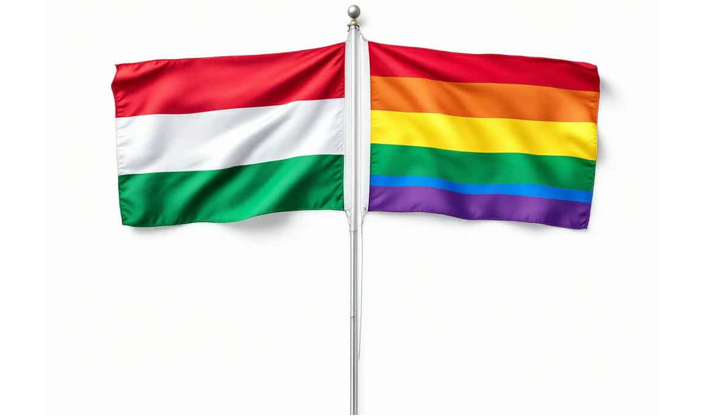
One of Europe’s oldest Pride marches—first held in 1997 and the first of its kind after the fall of the Iron Curtain—will go ahead tomorrow in Budapest, despite aggressive attempts by Viktor Orbán’s regime to repress and outlaw it. A large turnout is expected, defying a police ban enforced under draconian new laws passed by Orbán’s ruling party Fidesz. Budapest Mayor Gergely Karácsony has confirmed that the Pride march will proceed on June 28, 2025, as a municipally organized event—an open challenge to the government's authoritarian crackdown. The ban and accompanying legislation have drawn fierce condemnation from Brussels and civil society organizations across Europe and beyond.
The lead-up to this year’s Pride tells a deeper story of repression—one written in legislation, surveillance, and constitutional change:
On March 18, 2025, Viktor Orbán’s rubber-stamp majority in the Hungarian parliament passed a sweeping authoritarian law giving police the power to ban LGBTQ+ events under the guise of “child protection” and authorizing the use of facial recognition technology to track participants. Those identified risk fines of up to €500, while organizers face the threat of imprisonment for up to a year. This is just the latest escalation in Orbán’s war on LGBTQ+ rights, led by his ruling Fidesz party. In April, a constitutional amendment was enacted to legally recognize only two genders and restrict public marches—further institutionalizing discrimination. These measures build on the regime’s infamous 2021 “anti-LGBTQ propaganda” law, which effectively bans the representation of any identity other than heterosexual in front of minors. That law is currently under legal challenge at the European Court of Justice, and Hungary faces mounting condemnation and lawsuits from the EU for its blatant violations of fundamental rights.
Armed with the new authoritarian legislation, Hungarian police moved swiftly to deny an official permit for this year’s Pride, invoking the regime’s manufactured “risk to minors.” Furthermore, the police gave the green light to an anti-Pride far-right event the same day. In response, Budapest Mayor Gergely Karácsony activated what he called “Plan C”: reclassifying Pride as a municipally sanctioned Freedom Celebration, effectively bypassing the police veto and asserting the city’s autonomy in the face of state repression—Minister of Justice Bence Tuzson publicly threatened Karácsony with imprisonment. Civil liberties groups, including the Hungarian Helsinki Committee, have urged mass participation as a form of collective protection—arguing that a large turnout can blunt the regime’s use of facial recognition to target individuals. In a powerful show of defiance and solidarity, more than 70 Members of the European Parliament, numerous city mayors, and leading human rights organizations from across the continent have pledged to join or observe the event, turning Budapest into a flashpoint for European resistance to Orbán’s illiberal agenda.
Notably absent from the Pride conversation is the TISZA party, the rising center-right, pro-EU force led by Péter Magyar. Following its strong entry into Hungarian politics in the 2024 European elections—securing 30% of the votes, but trailing Fidesz’ 45%—and now leading national polls by 8-10%—TISZA has opted for strategic silence on LGBTQ+ rights. The party has focused its messaging almost exclusively on Orbán’s corruption, steering clear of polarizing cultural issues to maintain its broad, ideologically mixed support base. Behind the scenes, TISZA reportedly lobbied members of the European People’s Party (EPP) to refrain from participating in Budapest Pride, reflecting its cautious positioning. As a result, Irish MEP Maria Walsh will be the sole EPP representative at the event. Magyar himself has made no public comment on Pride, underscoring TISZA’s decision to treat it as a political third rail ahead of the 2026 parliamentary elections. Whether this calculated omission will cost the party support among progressive urban voters—or help consolidate a right-of-center coalition against Orbán—remains an open question.
“We asked people to consider that it helps Orbán, we didn’t ask anyone not to go,” according to a source close to TISZA told Euractiv. "Orbán put up a trap by creating a mess about the Pride. If we run into this trap, we help him divert attention from what he has to hide," an EPP spokesperson added.
The backlash to Orban’s latest anti-LGBTQ+ crackdown has reverberated across the EU though: More than 20 member states have formally urged the European Commission to take action, with 17 countries signing a joint letter in May 2025 demanding that Budapest repeal its April constitutional amendments and immediately halt the use of facial recognition at public gatherings. The letter also called on the Commission to trigger Article 7 proceedings and apply the EU’s budget conditionality mechanism to suspend Hungarian cohesion funds—tools previously used in response to democratic backsliding.
Pressure has also mounted within the European Parliament, where a majority has passed resolutions condemning Hungary’s laws and warning that symbolic gestures are no longer sufficient. MEPs are demanding that the Commission escalate legal proceedings at the European Court of Justice, where cases concerning both the 2021 “anti-LGBTQ propaganda” law and the 2025 ban are already underway.
The turning point may have come last week when Belgian Commissioner for Equality Hadja Lahbib publicly announced she would attend Budapest Pride—becoming the highest-ranking EU government official to do so. Her bold move raised the stakes for Brussels and put pressure on EU leadership to respond more forcefully. In what many saw as a reluctant but politically necessary shift, Commission President Ursula von der Leyen followed days later with a late-stage endorsement of the Pride event. Her statement marked a rare departure from the Commission’s typically cautious approach to Hungary—suggesting that mounting pressure from Renew, S&D, and Greens within the European Parliament had finally forced her hand.
Civil society in Hungary and across Europe is mobilizing fiercely. Daily protests challenge Orbán’s oppressive regime on the ground, while international NGOs like Amnesty International and the Citizens Take Over Europe coalition have gone beyond issuing statements—they are launching legal petitions and joining Budapest Pride in a show of solidarity that demands more than empty words.
For EU citizens, this moment is a clear warning: rhetoric alone will not protect Pride in Budapest. Without decisive action from the European Commission, other member states—such as Slovakia, Bulgaria, and Italy—where similar anti-LGBTQ+ measures are gaining ground, could follow Hungary’s lead with impunity. LGBTQ+ rights are not just a niche concern but a frontline battleground for the soul of the European Union. Protecting these rights means defending the very principles of human dignity, equality, and the rule of law on which the EU was founded. To remain silent or inactive in the face of Orbán’s crackdown risks normalizing the authoritarian, exclusionary politics of the far right—paving the way for similar assaults across the continent. What unfolds in Budapest on June 28, 2025, is more than a Pride march; it is a defining test of whether the EU will stand firm in its values or allow them to be eroded by those who seek to turn back the clock on freedom and inclusion.
Sources:
https://www.politico.eu/article/budapest-pride-hungary-mayor-defies-ban-viktor-orban/
https://elpais.com/sociedad/lgtb/2025-06-19/la-policia-de-hungria-prohibe-la-marcha-alternativa-al-orgullo-convocada-en-budapest.html
https://www.euronews.com/2025/03/18/hungary-passes-law-banning-pride-events-in-new-blow-to-lgbtq-rights
https://apnews.com/article/hungary-gender-constitutional-amendment-lgbtq-1234abcd5678
https://www.helsinki.hu/en/press-releases/
https://www.theguardian.com/world/2025/jun/18/meps-attend-budapest-pride-viktor-orban-hungary-lgbtq
https://www.euractiv.com/section/politics/news/tisza-poll-lead-hungary/
https://www.euractiv.com/section/politics/news/eu-equality-chief-to-attend-budapest-pride-despite-von-der-leyens-advice/
https://www.euronews.com/2025/05/28/eu-countries-condemn-hungary-lgbtq-laws
https://www.europarl.europa.eu/legislative-train/session-10/hungary-referral-ecj
https://curia.europa.eu/jcms/upload/docs/application/pdf/2025-06/ag_opinion_hungary.pdf
https://ec.europa.eu/commission/presscorner/home/en
https://www.amnesty.org/en/latest/news/2025/03/hungary-pride-ban-is-full-frontal-attack-on-lgbti-people-and-must-not-be-signed-into-law/
https://citizenstakeover.eu/2025/hungary-pride-ban-reaction
Do you like this page?