By Greta Vezzani
21/04/2026
On the 15th of April 2026, Stand Up For Europe together with partner organisation A Seat At The Table organised the online conference “Closing the Gap on EU Competitiveness”, with the aim of launching the COMPASS project. COMPASS stands for Competitiveness Policy for Accelerating Sustainable Solutions, and the main focus of this two years long project is to overcome times of geopolitical uncertainty through inclusive policymaking. As a transnational youth engagement project, COMPASS aims to tackle the growing democratic and social divide in Europe by empowering young people to participate meaningfully in shaping the EU’s economic and political future. The project expands across nine EU countries, namely: Belgium, Germany, Poland, Italy, Spain, Romania, Slovakia, Lithuania and Cyprus. Participants from these and many other countries joined the conference, and had the great opportunity to engage directly with high-level policymakers and experts. The conference was especially focused on the competitiveness between the EU and global actors: exploring the challenges that we are facing in the current global market and the possible solutions in order to make UE more competitive. The programme features a high-level panel discussion followed by thematic breakout sessions on key areas shaping EU competitiveness, including Tech and AI, Defence, Trade and Strategic Autonomy, Healthcare and Biotech, and Sustainability.
Panel Discussion: Bringing Youth together with Policymakers and Experts
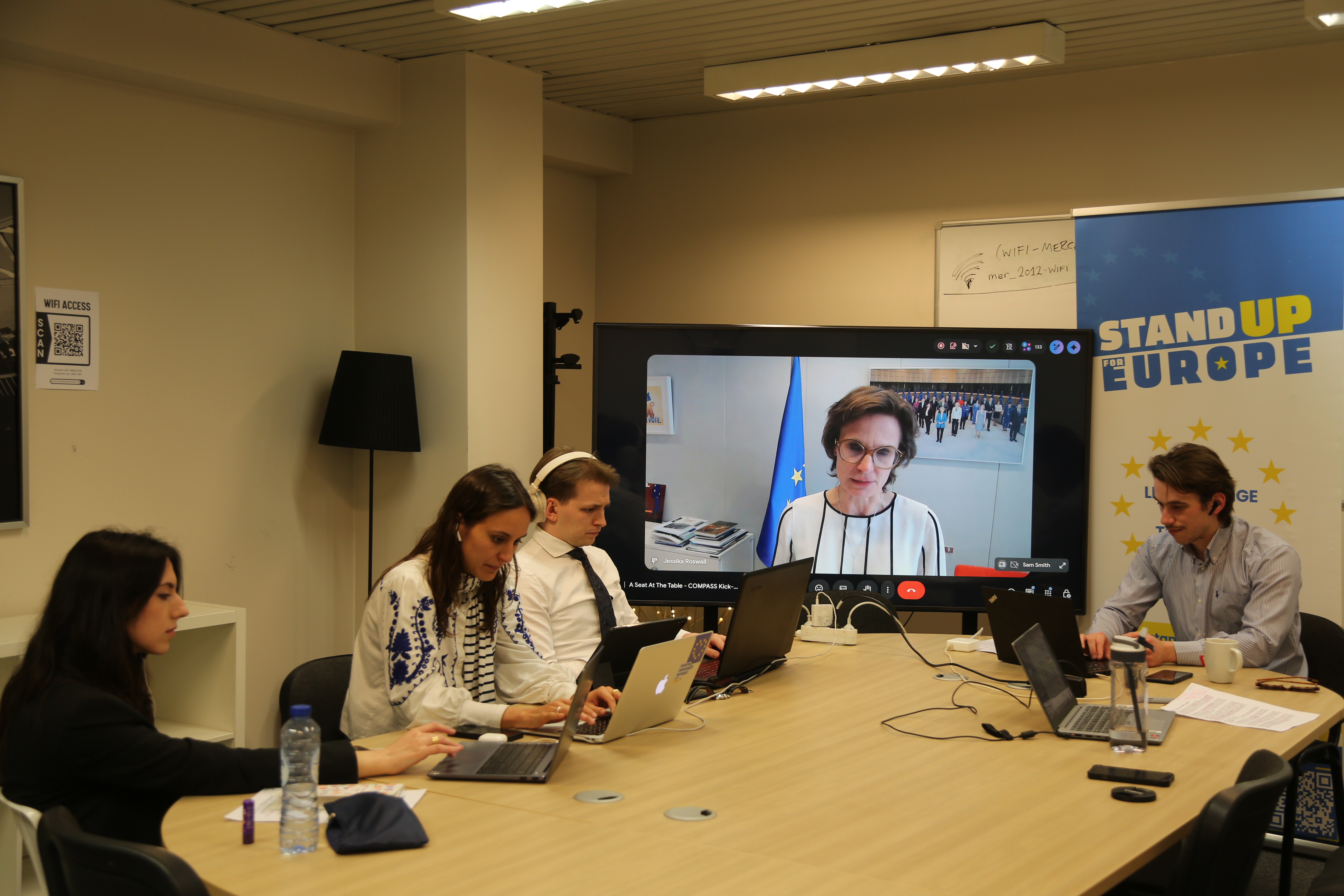
The first part of the event featured a keynote intervention by Jessika Roswall, European Commissioner for Environment, Water Resilience and a Competitive Circular Economy. She started her speech by identifying crucial problematic areas for European competitiveness and prosperity. Quoting former UN Secretary General Kofi Annan, she stressed that “young people are never too young to lead” and must be at the center of developing solutions to these challenges. Roswall then presented key policy questions for young citizens to address within the five aforementioned strategic areas tackled by the COMPASS project. The Commissioner noted the significance of innovative views: new skills, creativity, and a change in mindset are required in order to transition to a circular economy, for this reason, young people should be a part of the process.
The participants had the chance to enter directly in dialogue with the Commissioner through the Q&A session following her intervention. The questions asked concerned young people's contribution to EU policy making, the issue of water resilience and finally sustainability in times of competitiveness. In response to the first question, Commissioner Roswall encouraged young citizens to attend events and participate in open dialogues and calls for evidence. Furthermore, she advised participants to contact their local or EU representatives to share their views. Regarding the second question, she stated that water resilience is a key priority, especially because water scarcity and pollution pose a great risk to competitiveness and food security, therefore we must prioritise water regulations and "smart water" usage. While in response to the last question, she asserted that the green transition is not opposite to competitiveness, in fact, green transition represents Europe’s competitive advantage.
After Jessika Roswall intervention, the conference continued with a panel of high-level speakers and policymakers, including Susi Dennison, Joanna Drake, Nils Behrndt and Dana Adriana Puia Morel.
Susi Dennison, Director for European Power at the European Council on Foreign Relations, framed the competitiveness agenda within the context of international rupture, where long-held assumptions about institutional rules no longer function due to global disruption and the weaponization of economic power. She then outlined three main challenges we must overcome in order to enhance Europe’s competitiveness: first, understanding dependencies, vulnerabilities, and choke points; second, overcoming internal European divisions to operate as a cohesive, continent-sized power; and lastly, managing the political volatility that prevents establishing a solid, steady set of long-term policies.
Joanna Drake, Deputy Director-General of DG Research & Innovation, highlighted that rising geopolitical tensions, war, and long-term uncertainty could result in long-term repercussions, therefore it is fundamental to focus on long-run competitiveness and strategic autonomy. Drake acknowledged that Europe's economy has grown more slowly than the US and China, citing AI and technology-driven investment as major engines of global growth concentrated elsewhere, but also highlighted Europe's competitive advantage in AI-enabled science due to world-class researchers and scientific data. Europe must therefore address the broader innovation gap.
On another side, Nils Behrndt, Deputy Secretary-General of the European Commission, emphasized that Europe is, first of all, a “peace project” and remains strong in competitiveness. He noted that, with the dissipation of the three historical bases of competitiveness (cheap energy, US-guaranteed security, and open trade), the EU should better focus on closing the digital innovation gap, joining decarbonization and competitiveness as a single agenda, as well as increasing security to reduce dependencies, as mentioned in the Draghi report.
Finally, Dana Adriana Puia Morel, Policy Officer at DG GROW focused on the role of small and medium-sized enterprises (SMEs), that are vital drivers of the EU economy and are now being negatively affected by the economic challenges. She proceeded to explain the European Commission's SME policy and its three-pillar approach: supporting SMEs to start up and secure financing, limit administrative burdens, and helping them grow within the European market and beyond. The initiatives demonstrate the Commission's commitment to ensuring SMEs thrive in the European economy.
After the panel discussion there was time to address some questions that the participants asked, thanks to which a number of compelling issues could be tackled. The discussion focused on how the EU can remain competitive in the face of growing pressure from the US and China, particularly in areas like AI and clean technology. To address this problem, the European Competitiveness Fund is targeting key strategic sectors while also emphasizing the importance of digital and entrepreneurial skills. A cultural shift toward greater risk-taking and learning from failure was highlighted as necessary for innovation, especially among younger generations. At the same time, efforts are being made to empower women and girls in STEM by tackling confidence gaps and persistent stereotypes that limit their participation.
5 Pillars of Competitiveness: Asking the Youth for their Perspective
The first half of the conference concluded by moving from discussion to action inviting participants to choose one of five thematic pillars (Tech and AI, Trade and Strategic Autonomy, Defense, Healthcare and Biotech, and Sustainability) to discuss in breakout sessions. The participants could choose which group to join, based on their specific interest. In this way, we had the opportunity to engage as groups in outlining problems and possible solutions.
In the Healthcare and biotech breakout session, the participants tackled the Draghi report as well as the European Biotech act, identifying critical points such as the lesser R&D investment In Europe, and the slow regulatory framework. The discussion then moved to more specialised sectors, such as the European advantage in mRNA research, and how member states could join their efforts and minds to invest in this specific field of research. The consensus was that the EU should work as a united actor, placing funds to assure dominance in relevant fields.
Similarly, in regards to Trade and Strategic Autonomy, the discussion highlighted that while the EU is economically strong, it relies heavily on external partners for key resources, making it vulnerable in times of crisis. Participants agreed that full independence isn’t realistic, but reducing risky dependencies is important. Overall, the focus was on finding a balance between staying open to global trade and strengthening Europe’s resilience through better partnerships and supply chains.
Regarding the Sustainability group, the discussion reviewed the EU's leading sustainability position and the threats represented by competition and fragmentation among member states, which also hinders the adoption of green technologies. The participants agreed that to improve sustainability competitiveness, the EU must work jointly, prioritizing research and its own capacity to build sovereignty in carbon-heavy industries to avoid strategic reliance on trade partners.
The Tech and AI debate was especially focused on AI technologies and related competitiveness challenges. Two critical issues were identified: responsible use of AI and Europe’s difficulty scaling AI companies. The consensus was that the EU must invest more in both AI education and technological sovereignty: better media literacy and a focused toolkit for European education as well as EU owned AI champions to compete globally and secure sensitive data.
The breakout session focused on Defence discussed ways that the EU can face the growing geopolitical threats. The group identified some key challenges hindering the EU defence agenda: economic constraints, fragmentation among Member States and outdated systems. Although some considered independence as highly unrealistic, increased trust and collaboration with neighboring countries, resulting in long-term cooperation, is seen as beneficial, and might become a solution against dependence on other global regions. Overall, balancing sovereignty with stronger collaboration is central to the future of EU defence policy.
Conclusions
As the conference came to an end, it became clear that “Closing the Gap on EU Competitiveness” marked an important starting point for the COMPASS project, successfully bringing together young people, experts, and policymakers to exchange ideas on Europe’s economic future. By fostering open dialogue and active participation, it highlighted both the challenges the EU faces in a changing global landscape and the value of inclusive, youth-driven policymaking. More importantly, the conference demonstrated that young people across Europe are ready to engage with complex issues and to contribute thoughtful perspectives across key sectors to assure a more competitive, resilient, and inclusive European Union.
Do you like this page?