By Vladimir Kovtun
5/12/2025
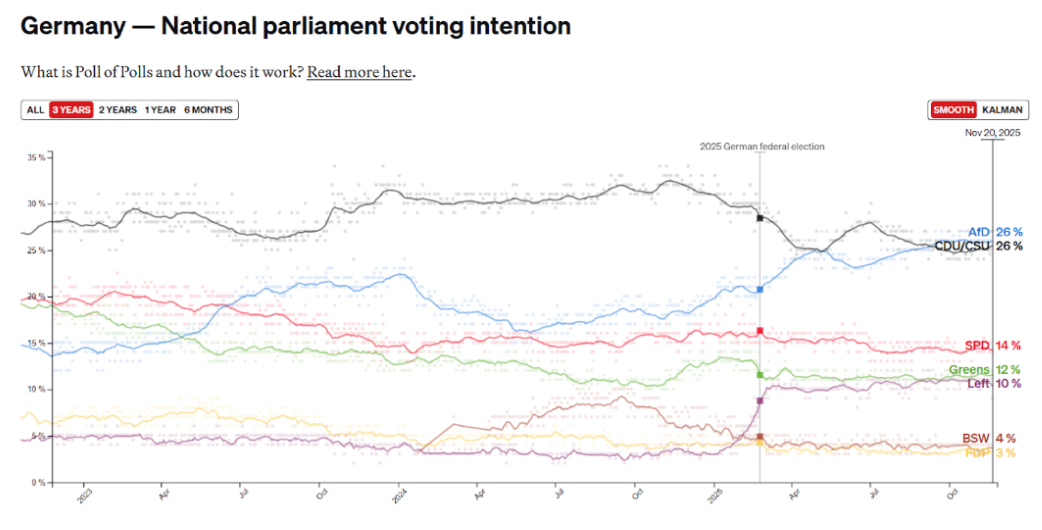 (Politico, 2025)
Preview:
Over the past few years, Germany has seen the worrying rise of the far-right Alternative for Germany (AFD) party from the radical fringe to one of the highest polling parties in Germany at 26% support. As part of this shift to the mainstream on November 30th they founded a new youth wing “Generation Deutschland” to great fanfare, which will play an important role in the party’s attempts to rise to power. Worryingly even their designation as an extremist group by Germany’s Federal Office for the Protection of the Constitution has not dissuaded voters. Especially in the context of a country where a rejection of the Nazis' ruling practices was seen as core to their modern national identity, these developments may seem surprising to outsiders. This shift was facilitated by the rise of social media, as it enabled radical ideology to gain a wider reach than otherwise possible. However, the success of far-right social media campaigns was only possible due to longstanding political grievances, including the migrant crisis and the rising economic inequality seen in Germany.
Context:
The AFD itself is emblematic of a major shift in German society. Originally, the party was considered a “party of professors” founded as a liberal, eurosceptic party that mainly focused on economic issues. Yet especially in the aftermath of the Syrian migrant crisis, the party shifted towards more radical, xenophobic rhetoric, providing it a more populist appeal. This strengthened a more nationalist identity for the AFD, with the party developing informal connections with extremist groups like the Identitarian movement and The Homeland (NPD). As the party radicalized it shifted its attention towards younger voters, and put its focus on a large scale social media outreach strategy in order to draw this demographic. By now, it has almost completely shed its liberal skin to become a fully populist party focusing on social issues and eroding post-war taboos. They have run into issues with the law before, dissolving their former youth wing Jungend Alternative because its open ties to extremist groups put the AfD at risk of being banned. The party’s platform focuses on restricting migration, rolling back Germany’s participation in the EU, and promoting German conservative values.
Social Media and the AFD:
The AFD takes a two-pronged approach to its social media strategy. Firstly, it has created an alternative media ecosystem on social media, discrediting mainstream platforms while sharing provocative stories. This helps them reach a part of the German electorate that has been disenchanted in the traditional media, building a reliable base unchallenged by opposing views. Secondly, the AFD tries to create a sense it has greater support than it actually has to create a sense of consensus. This exploits the bandwagon effect, where people are psychologically more willing to support a position if it is broadly supported by their fellow community members. To do this, it tries to exploit social media algorithms that promote high volumes of provocative content that attract clicks. They do this through encouraging supporters to post as much content as possible and using social bots to create a greater sense of cohesion.
The AFD’s strategy seems to have been successful. From 2015 to 2018, the AFD was by far the most active German party on Twitter, with 9193 tweets compared to the ruling CDU/CSU’s 7,797. In the same period, the party led in bot usage, which consisted 32.9% of the retweets of its post. Undoubtedly, the AFD used social media most effectively out of the German parties, and there was a correlation between increases in public support and its social media use. However, there was no proven causation between the AFD’s social media policy and its gains in the polls. As such, additional factors need to be considered to build a full picture of why the party was able to gain so much support.
Migrant Crisis:
The migrant crisis was a clear factor that pushed the German alt-right towards success. Overnight, Germany underwent major social changes, which many voters came to reject. 81% of Germans opposed Chancellor Merkel’s handling of the refugee crisis, which allowed for millions of asylum seekers to enter the country. Especially in the wake of a series of attacks blamed on migrants, Germans began supporting limiting or even reversing migration. It has been found that misleading political narratives tend to dominate the discourse on migration, a key issue that German moderate politicians will have to solve if they want to popularize migration. The AFD capitalized on this discontent to show itself as the one party willing to follow public opinion, attracting many otherwise moderate voters.
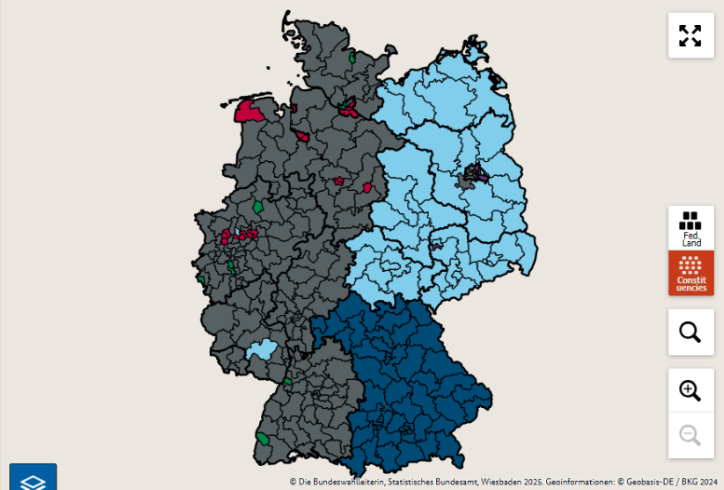 Key:
Key:
Black: CDU (Christian Democratic Union)
Indigo: CSU (Christian Social Union)
Light Blue: AFD (Alternative For Germany)
Red: SPD (Social Democratic Party)
Purple: Die Linke (The Left)
Green: Die Grunen (The Greens)
Election results 2025, mapped (Federal Returning Officer, 2025)
The East German problem:
Despite Germany’s overall developed status, its regions formerly part of East Germany (DDR) continue to experience relatively poor economic conditions. Germany’s government has invested heavily in developing the former DDR territories, but these investments have been insufficient to bridge the gap. Even though disparities in health outcomes and wealth have shrank, there is a massive gulf between cities like Berlin and more rural areas, where these outcomes actively worsened after reunification. As of 2018, the bottom 90% of East Germans had just half the income of their West German counterparts. This is mainly due to a lack of access to capital in the region, where the German government failed to recognize the need for East Germans to gain access to what assets were available, selling most former state-owned properties to West German-based investors. This resulted in a greater concentration in the ownership of the means of production, solidifying the disadvantage East Germans have in acquiring wealth. To this day, firms from the former DDR have an average annual revenue of 1.2 million euros, as compared to the 2.4 million euros earned by the average firm in the West. There is clear evidence that this experience of inequality leads to far-right radicalization. According to the IFO Institute for Economic Research, it has been found that regions with growth that does not keep up with the national development average on average vote 1.2% more for far-right parties for every 1% increase in the poverty gap. In part due to these effects, authoritarianism remained broadly more popular in East Germany than in the country at large, as of 2024, a majority of East German participants polled wanted a return to authoritarian leadership, and almost a quarter of respondents said that nazism had its benefits.
Solutions:
Any response meant to curtail the rise of the AFD needs to answer the political grievances and economic inequality that drive the party’s support. Firstly, there is a need for a new development package for Germany’s Eastern regions, given their continued underdeveloped status compared to the West. Such a plan should focus on developing local capital, focusing on supporting existing businesses and encouraging the development of new ones through tax incentives. Germany could also concentrate on the development of new military-industrial production capabilities necessitated by their military buildup in East Germany. This would allow for a reversal of the region’s deindustrialization trend, which worsened the region’s prospects, bringing back jobs similar to what was available before reunification.
Another workable solution would be to introduce citizens’ assemblies on controversial political topics to work alongside Germany’s political organs. The experience of Chancellor Merkel’s immigration policy shows that, regardless of whether politicians view public opinion as something inadvisable, attempting to forgo it can bring heavy consequences. Citizens' assemblies give voters a sense that they have political input without having to support extremist parties, and also a forum from which they can more directly engage with politicians themselves. This would help foster trust in Germany’s government and perhaps give citizens access to information they would need to create a more informed outlook on key topics.
Over the next few years, Germany’s mainstream parties will face a difficult challenge confronting the AFD. The party has gained enough popularity to gain institutional strength, and its popularity among young voters provides a base it can rely on throughout the next elections. However, the party still has a way to go in order to achieve power. With the firewall against the AFD the party will be unable to enter government as long as it does not enjoy majority support on its own. As long as this is respected, there is time for needed reforms to be made to deal with German voter’s grievances. Though it may be tempting for the ruling CDU to break the firewall occasionally for political gain, this must be avoided as elsewhere this practice has been shown to normalize alt-right ideology to voters. Needless to say in Germany’s case this has been shown to have potentially disastrous consequences.
Sources:
https://www.politico.eu/europe-poll-of-polls/germany/
https://www.jstor.org/stable/27668292?searchText=German+national+identity&seq=7
https://www.nytimes.com/2024/06/23/world/europe/germany-extremism-hocke-afd-nazi.html
https://dl.acm.org/doi/10.1145/3328529.3328562
https://philosophy.lander.edu/logic/popular.html#footnote-11
https://doi.org/10.1007/s00038-007-6116-8
https://www.ecineq.org/wp-content/uploads/2023/06/EcineqAMSE-136.pdf
https://www.dw.com/en/half-of-eastern-germans-want-authoritarian-rule/a-66068519
https://www.nytimes.com/2025/02/23/world/europe/germany-election-firewall-afd.html
Do you like this page?